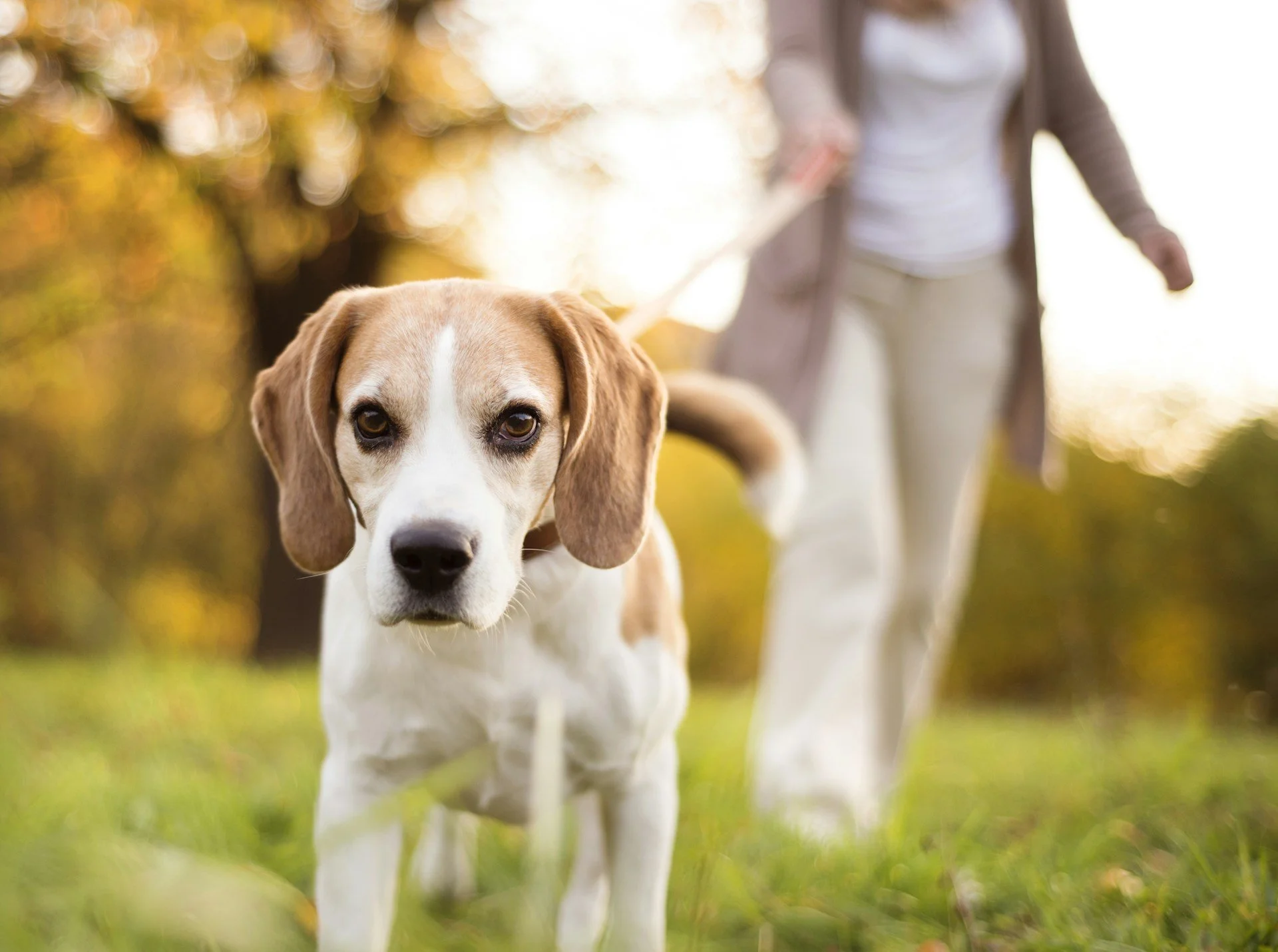
You have tried the front-clip harness. You have tried the head halter. You have tried stopping every time the leash goes tight, standing on the sidewalk like a statue while your dog stares back at you, baffled.
And your shoulder still hurts.
Here is what nobody told you: the equipment was never the problem.
Why Dogs Pull in the First Place
Your dog is not pulling to dominate you. He is not being stubborn. And he is definitely not doing it to make you miserable, even when it feels personal on a rainy Tuesday morning.
Your dog pulls because pulling works.
Every time he surges forward and the walk continues, he learns something. Pull, and the world gets closer. That is the entire mechanism. He has been running a very successful experiment on you for months, and it produces results every single time.
A harness does not change the lesson. It just moves where the rope sits on his body.
Why the Walk Falls Apart in the First Hundred Feet
Watch what happens before you leave the house.
The leash comes out. He is already spinning. By the time the door opens he is at a nine out of ten, and you are trying to teach a dog who is in no state to learn anything.
Most walking problems are not walking problems. They are what happened in the two minutes before the walk.
Three Things to Stop Doing Today
Stop letting the pull work. If forward motion happens while the leash is tight, the lesson is being reinforced in that exact moment.
Stop starting the walk at a ten. Whatever ritual currently winds your dog into a frenzy before the door opens is the first thing to change.
Stop buying equipment to fix a communication problem. The harness aisle is not where this gets solved.
The part That Actually Changes Things
Here is what twenty-two years has taught me, and it is not a technique.
A dog who ignores you and a dog who watches your every move are the same dog. The only thing that changed is the trust between you.
When your dog genuinely trusts your direction, the leash becomes almost irrelevant. It stops being a rope you steer with and becomes what it was always meant to be, a seatbelt.
You do not get there with gear. You get there by changing what you are doing on the other end of that leash.
A Dog Named Chance
Chance (before video) was six months old and had never been on a walk. Not once.
When I met him he was not pulling ahead. He was frozen. Planted. Completely overwhelmed by a world nobody had taken him out into, and his owner was gently trying to move a puppy who had no idea what any of this was.
After we worked together (after video), Chance was prancing. Panting. Draining energy he had never been allowed to spend. It looked like a burden had come off his shoulders.
Same dog. Same leash.
I film these, because people do not believe it until they see it.
What if He Pulls Toward Other Dogs Specifically?
That is a different problem, and it matters that you know the difference.
General pulling is about excitement and habit. Lunging or barking at other dogs is reactivity, which is usually rooted in fear or frustration rather than enthusiasm. It needs a different approach, and honestly it needs someone watching your dog in person.
If your dog is fine on an empty street and comes unglued the second another dog appears, that is the one to call about rather than work through alone.
Which one sounds like you?
"My puppy never really learned to walk." Easiest version of this. We are writing on blank paper.
"My dog is fine until he sees another dog." That is reactivity, and it is very solvable, just differently.
"He is strong and honestly I am worried about getting hurt." I have handled a lot of powerful dogs, including years of rehabilitating shelter pit bulls. This is a safety conversation and it should be.
The Walk You Actually Wanted
You did not get a dog so you could dread going outside.
I train in your home and on your street, which is where the pulling happens, so nothing has to transfer from a training room to real life. No sending your dog away for two weeks. No wondering what happened while he was gone.
I work across Cincinnati, including West Chester, Liberty Township, Mason, Deerfield Township, Blue Ash, Montgomery, Loveland, Symmes Township, and Sharonville.
I offer a free dog training consultation.
[ Schedule a free consultation ]
No pressure, and if I am not the right fit I will tell you that too.